
Classic Car A/C Modernization: Why Is It Not Enough to Simply “Refill It with New Gas”?
A Mercedes-Benz 280 SL (W113) Case Study from the Widi Automotive Workshop
Some people swear that a classic car does not need air conditioning. “Just roll down the window, press the throttle, and enjoy the breeze,” they say.
To some extent, we can agree with that. However, there are people and situations where this argument simply does not hold up. Let’s be honest: when you have worked your whole life to finally own your beloved classic car, you do not want to be sweating in a summer traffic jam.
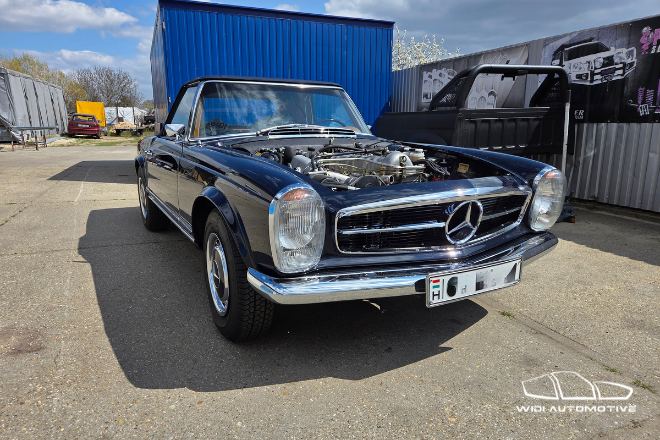
This Mercedes-Benz W113 - also known as the Pagoda Mercedes - arrived at our workshop because it tended to overheat in Budapest summer traffic, while the air conditioning was also performing very poorly.
The two problems were not independent from each other: a poorly functioning, ageing A/C system can significantly contribute to excessive engine heat.
If you are interested in how we managed to keep the engine cooling stable while also making the A/C work perfectly at maximum performance, blowing air as cold as 4 °C into the cabin, read on.
How Can Weak Air Conditioning Cause Engine Overheating?
Running the A/C compressor takes power from the engine. This is typically in the range of a few horsepower. At first, this may not sound like much, but in urban traffic, at low speed and low engine rpm, this extra load becomes noticeable. In these conditions, the additional load is proportionally more significant.
This alone would not be a problem if both the engine cooling system and the A/C system were in perfect condition.
But in a classic car that is more than 57 years old, this is rarely the case.
The inside of the cooling system is usually contaminated to some extent. The radiator fins are certainly no longer perfect, and they are often partially clogged with dirt and debris.
When the A/C compressor is working properly, it operates in cycles. It switches on, builds up pressure, then switches off. In this case, the additional load is only present for short periods.
However, if the compressor is in poor condition or the system is not working correctly, the compressor takes much longer to reach the required pressure, or may not reach it at all. As a result, it runs continuously, without stopping.
On top of this, the Pagoda Mercedes did not come with factory-installed air conditioning. In these cars, the A/C system is typically a so-called “dealership A/C” system, meaning it was installed later by the dealer, often using a Frigiking unit.
This means that although the factory cooling system does have a certain safety margin, it was not originally designed for the additional thermal load created by air conditioning.
One of the weak points of the aftermarket A/C system was the condenser, which proved to be too small. There was also an additional small condenser installed behind the bumper, but in that position it receives very limited airflow, so it was not particularly effective.
The critical situation is always prolonged idling. While driving, there is enough airflow through the radiator, but at idle the engine-driven fan is often not enough.
And this is where many small issues add up: the coolant starts to boil while we are sitting in traffic, trying to create a liveable temperature inside the cabin.
In our case, the problem was made even worse by the fact that the system contained less than half of the required amount of refrigerant. This meant the A/C compressor had no real chance of creating the correct pressure.
For example, during a previous Mercedes W114 A/C project, we observed that the average engine coolant temperature was approximately 10 °C higher when the air conditioning was in use.
This clearly shows that the A/C system in a classic car is not an isolated system. It directly affects the engine’s thermal balance.
The Problem Gets Worse: Old Technology in a Modern Environment
One characteristic of classic cars - regardless of which subsystem we are talking about - is that components wear out over time. Another common issue is that many people may have worked on the car over the years: some professionally, others less so.
In most cases, the exact history is unknown. We often do not know when certain parts were installed, what refrigerant was used, what oil is inside the system, whether there had been previous leaks, or whether any improper repairs were carried out.
Modernizing an A/C system, or converting it to R134a refrigerant, is not rocket science. However, there are important rules that must be followed in order to achieve a good, stable and truly long-lasting result.
Improper repair often leads to unstable operation. If the oil is not compatible with the refrigerant, it can cause corrosion inside the system, which may even cause the expensive compressor to seize.
If the refrigerant quantity is incorrect, cooling performance will be poor. If the condenser size and cooling capacity are insufficient, the system will not cool properly. If the internal evaporator - through which cold air enters the cabin - is not thoroughly cleaned, unpleasant smells or even mold can develop.
This is why it is worth leaving the job to specialists.
A Few Words About Refrigerant
In the past, several different refrigerants were used, but most of them have been phased out or banned because of their ozonelayer-depleting effect and their contribution to the greenhouse effect.
From the mid-1990s onwards, car manufacturers typically used R134a refrigerant. It is important to understand that an older A/C system can be converted with relatively small modifications so that it operates properly with R134a gas.
At Widi Automotive, we carry out this process according to a defined protocol.
The main steps are:
complete and thorough system cleaning because of the oil change,
replacement of the compressor oil with R134a-compatible oil,
replacement of the receiver-drier,
replacement of the expansion valve,
thorough pressure testing and elimination of all leaks,
cleaning of the internal evaporator,
comprehensive testing and inspection,
and finally, ozone-generator disinfection.
The receiver-drier should be replaced periodically anyway. Its price is typically around 45 to 90 Eur.
The expansion valve needs to be replaced because the correct valve is required for the specific refrigerant being used. Its cost is usually in a similar range.
Thorough pressure testing is one of the foundations of long-term stability. The A/C system must not leak. Naturally, the amount of refrigerant may decrease over time, which is why it is worth checking the system once a year. However, with proper pressure testing, faulty points can be identified and leaks can be eliminated.
We always clean the internal evaporator, and finally we also carry out ozone-generator disinfection to ensure that clean, cold air without unpleasant odours enters the cabin.
What Did We Do on This Mercedes Pagoda?
In the case of this Pagoda, a complete A/C overhaul and modernization was carried out. The goal was to make sure the air conditioning worked reliably even in the hottest summer weather, while standing in traffic, and that the engine cooling also remained safe.
Essentially, we followed the steps described in the previous section, with a few important additions. In this case, we also wanted to improve the efficiency of the old Frigiking system and solve the engine overheating issue.
The problem mainly occurred at idle, in traffic. In this situation, the engine rpm is low, the car is not moving, and therefore the amount of air flowing through the radiators is very limited.
In such conditions, the factory mechanical fan is not always able to provide enough airflow, especially when the A/C condenser is also releasing additional heat in front of the radiator.
For this reason, we replaced the fixed factory mechanical fan with an electric fan solution. Two fans were installed on the radiators: one medium-output unit and one higher-output unit.
The fans already operate at low speed when the engine is running. They switch to full power in two cases:
when the engine coolant reaches a certain temperature,
or when the pressure on the condenser side of the A/C system reaches a defined value.
This solution is important because it does not only react to engine temperature, but also to the load on the A/C system. This means the system can provide additional airflow exactly when the A/C pressure conditions require it.
The fans required additional electrical power, so it was also necessary to install a higher-output alternator.
We also further increased the efficiency of the A/C system, but how exactly we did that will remain my secret for now. If you are interested in how we achieved the results below, bring in your Pagoda and we will do it for you.
The Results in Numbers
After the modernization, the system operated reliably even in extreme summer heat, while standing in traffic with the air conditioning switched on.
the cabin temperature dropped from 26 °C to 18 °C in 8 minutes,
the internal A/C unit blew air as cold as 4 °C at maximum output,
the engine temperature remained stable at idle, with the A/C on, in direct sunlight.
This result was not achieved by a simple A/C refill. It was the result of a carefully planned classic car A/C overhaul and modernization.
Widi Automotive Classic Car A/C Modernization
At Widi Automotive, we do not treat classic car A/C repair and modernization as an isolated mechanical task.
We know classic cars well, and we understand that in a classic vehicle the systems are often interconnected: the engine, cooling system, air conditioning and electrical system all affect each other.
This is why we first understand the problem, then look for a solution that is stable, reliable and suitable for the specific car in the long term.
If you are planning classic car A/C modernization, classic car A/C repair, conversion to R134a, or a complete classic car restoration, it is worth inspecting the entire system instead of simply treating the symptom.
The goal is simple: a classic car that is not only beautiful, but truly usable.
