
Classic Car A/C Modernization FAQ
In this article, we summarize the most important questions and answers about oldtimer and youngtimer A/C repair, A/C modernization, and conversion to R134a.
How is the A/C system of an old car different from that of a modern car?
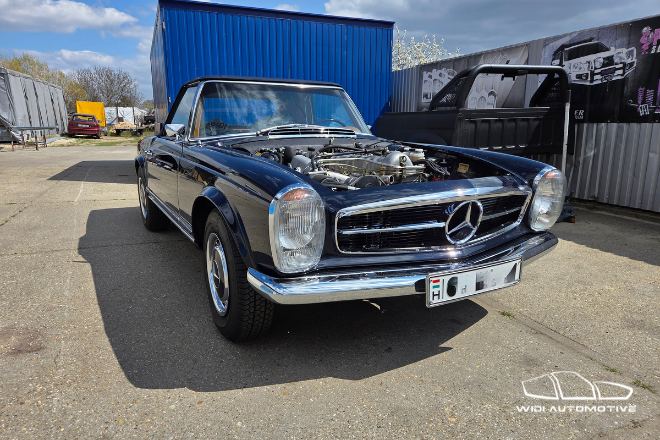
The A/C system of a 30-, 40-, or even 60-year-old car was designed for a different era. Back then, there were fewer city traffic jams, the average temperature was lower, and in many models, air conditioning was not even a factory option, but an aftermarket or dealer-installed system. Therefore, it is possible that the system was already a compromise even when new.
An example of this is the dealer-installed A/C system of the Mercedes-Benz W113, also known as the Pagoda, whose efficiency they even tried to improve with an extra condenser hidden behind the bumper. If you are interested in more details, read our Pagoda A/C case study.
Over the decades, the seals age and begin to leak, while the condenser fins are typically damaged, reducing their heat transfer capability. In addition, they are prone to clogging from dirt both externally and internally. The compressor wears out, and the quality of previous repairs is often not the best.
Why is it not enough to simply refill an oldtimer A/C system with gas?
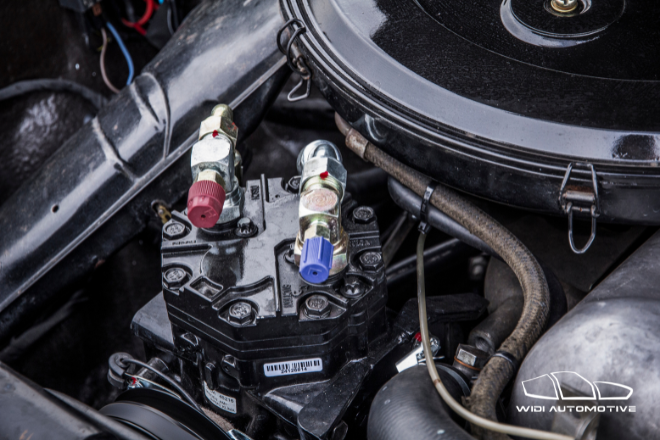
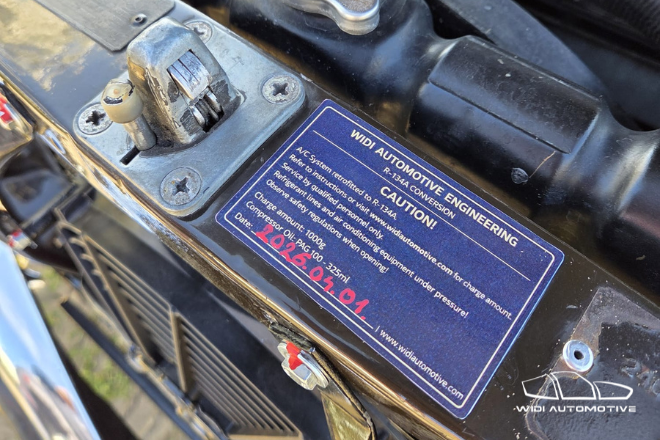
One of the most important issues is that before the mid-1990s, car manufacturers used different refrigerants, typically R12. This was phased out or banned for environmental reasons. In later systems, R134a was the commonly used refrigerant for a long time, and it is still usable and widely applied today.
However, R134a gas must not simply be filled into an old system that was originally designed for a different refrigerant. The compatibility of the refrigerant with the compressor oil and the expansion valve is a key issue. If this is ignored, the system may fail within a short time.
In addition, the reason for poor cooling is rarely only that “there is not enough gas in it”. If the refrigerant disappears from the system, there is a reason for it: a leak, which must be systematically found and eliminated. Poor cooling performance can also be caused by a worn compressor or a low-efficiency condenser.
After a simple top-up, the A/C may blow cold air for a short time, but this does not mean a durable and reliable solution. A professional oldtimer A/C overhaul therefore begins with the assessment of the entire system.
Why is it dangerous to top up an old system with a new refrigerant?
Old systems often used mineral oil, while R134a requires a different type of compressor oil. If the wrong oil is present in the system, mixed with R134a gas, it can result in oxidation and may lead to compressor failure within a short time.
Therefore, when converting an old system to R134a, the entire system must be thoroughly flushed so that all previous oil is removed from the system.
Click the button to protect your beloved classic car and entrust your air conditioner to the hands of a professional restorer
Why does the A/C affect engine cooling?
The A/C compressor is typically driven by the engine via a V-belt or serpentine belt. This means that operating the A/C takes power from the engine. The more power the engine has to produce, the more heat it generates. This in itself is a normal phenomenon.
Another important factor is that the A/C condenser is usually located in front of the radiator. When the A/C is operating, the condenser releases heat, so the radiator no longer receives the outside airflow directly, for example at 30 °C, but instead receives air that has passed through the condenser and has been heated up. This reduces the efficiency of the engine cooling system.
The problem typically becomes most noticeable in summer traffic jams, when there is no natural airflow. In this situation, due to the factors described above and the reduced airflow through the radiators, the coolant may even boil — especially if the cooling system is already slightly dirty, which is common in older cars.
A low-efficiency A/C system further worsens the situation. Ideally, the A/C compressor operates intermittently: it builds up pressure, then switches off. This way, the additional load on the engine only occurs periodically. However, if the compressor is worn, or the system is not working properly, pressure builds up more slowly, so the compressor may even run continuously. This permanently increases engine load and heat generation.
Why can the A/C blow bad-smelling air?
The internal evaporator is the heat exchanger located in the cabin unit. This is where the refrigerant evaporates, and this is where the air flowing through it is cooled. This cold air then enters the cabin.
Because the evaporator is cold, moisture from the air condenses on it. This is a natural process, but over time, mold, fungi, and various contaminants can easily settle on the wet surface. These cause unpleasant odors and are also not good for your health.
The situation is even worse if there is already dust or other deposits inside the internal unit. When this comes into contact with moisture, it provides a perfect breeding ground for the microorganisms that cause unpleasant odors.
For this reason, regular cleaning of the internal unit - once a year - is recommended, as well as ozone-generator disinfection of the cabin. In a classic car, this is especially important because the ventilation system has often not undergone thorough cleaning for decades.
Click the button to prevent unpleasant odors in the passenger compartment!
How durable is a properly carried out oldtimer A/C modernization?
If the system has been professionally converted, cleaned, pressure-tested, and assembled with the correct oil and compatible components, then it will operate reliably in the long term.
However, it is important that the A/C system - just like the other subsystems of the car - is checked and maintained from time to time. It is worth inspecting the system once a year, checking the refrigerant quantity, and cleaning the internal evaporator. In addition, ozone-generator disinfection of the cabin and, together with it, the internal A/C unit is also recommended.
What counts as a good result after an oldtimer A/C modernization?
A good result is not only that cold air comes from the vent. The real goal is that the system operates stably in summer heat, while crawling in traffic and at idle.
After a successful oldtimer A/C modernization:
the A/C cools effectively not only while driving, but also when stationary and at idle,
there is no unpleasant odor in the cabin,
the engine temperature remains stable even when the A/C is in use,
with regular annual maintenance, the system operates reliably for many years.
At Widi Automotive, this is the goal with every A/C modernization. We do not perform temporary repairs; we build stable, usable, and long-term reliable systems.
If you are also interested in specific, measurable results, watch the video below:
Learn more about our air conditioning modernisation service!